
Every collaboration is different, but the question underneath often looks alike: how do we get more out of this team? Below you can read what that looks like in practice. Seven real projects, from a quiet operations team to 54 leaders at once. Out of respect for our clients we tell their stories without company names: just the industry, the team and what happened.
These figures come from several hundred of our own evaluation forms, completed directly after each session.
How a quiet operations team found a shared language for feedback
The situation
A good team, running smoothly. But also: a quiet team. Giving feedback, talking about how you work and what you need from each other, it simply didn’t happen. Recognisable for many operations teams. And in a fast-growing company also risky, because what runs smoothly on routine today starts to grind the moment roles and processes shift.
The approach
We spent a half-day working with Extended DISC: every team member received a personal behavioural profile, the team as a whole a team map. No boxes, no labels. Just a shared language for the things you don’t usually talk about: how you decide, how you communicate, what drains your energy and what fuels it. Everyone wrote their own “How to work with me”, and each team put its strengths and blind spots on the table.
What happened
The best moment? The quietness turned out not to be distance. Once the language was there, colleagues simply gave each other feedback, right there at the table. Others said out loud what they want to work on, and immediately got the team’s support. Everyone went home with a concrete action plan for daily work.
“Roselind was perfect!”
Recognise this team? Good people, but the real conversation doesn’t start by itself. We’d love to help. Explore the DISC workshop or have a coffee with us.
When everyone is alike: the blind spot of a close-knit team
The situation
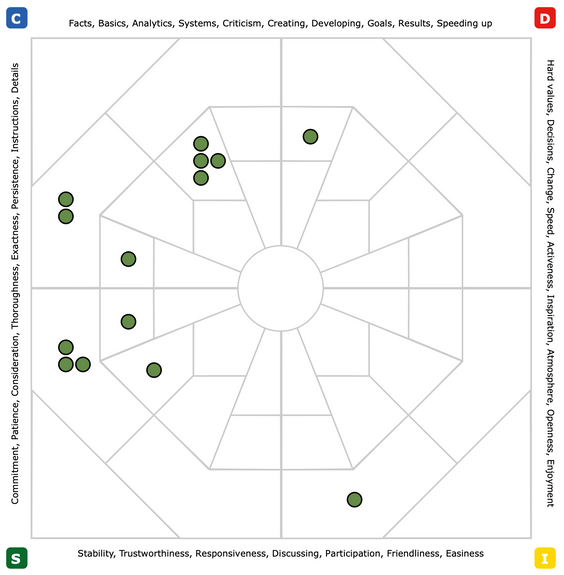
Honestly: at first glance there was little to improve here. This operations team ran tight and smooth. Clear roles, strong ownership, good atmosphere. Until the team map landed on the table. It showed something nobody had said out loud: almost everyone on this team has the same style. Careful, steady, focused on harmony.
Why that matters
A team where everyone senses each other, that works wonderfully. But a team without a counter-voice also misses something: the pressure to speed up, the voice that asks “is this really the right plan?”, the sharpness that comes from a little friction. That is exactly why a team map is so valuable: it shows not only what you have, but also what you lack.
What happened
In half a day we dove into the personal profiles and the team map together. Everyone created a “How to Work With Me”, and we openly discussed what that striking similarity means: for how this team decides, accelerates and organises dissent.
“Thank you for your guidance and dedication. Your training has truly made a difference!”
Curious what your team map would show? We’d gladly make one for you. Explore the DISC workshop or send us a message.
The harmonious team that learned to disagree
The situation
This team had something many companies would love to have: a strong bond, clear roles, real ownership. And yet something chafed. Disagreeing was not really done here. Differences of opinion were neatly avoided, the peace kept. Nice for the atmosphere. Less nice for the decisions, because the best ideas come exactly where people dare to contradict each other.
The approach
A full day with Extended DISC: personal profiles, a team report and the “How to Work With Me” exercise. The team map showed how diverse this team actually is: very different styles, each with its own pace and preferences. And where cultural background helps determine what you do and don’t say out loud, such a map gives something important: permission to talk about it anyway.
What happened
The conversation landed exactly where it needed to: on the things that normally remain unspoken. Openness became the theme of the day. With psychological safety as the foundation, and a concrete follow-up path toward a culture where feedback is simply welcome.
Do people at your company also walk around the real conversation? Explore the DISC workshop or the Cultural Dynamics workshop. Or just ask us what we would recommend.
DISC for 54 leaders: from team insight to leadership strategy
The situation
Usually we train one team. Here it was the entire top of the company: 54 leaders, from team leads up to and including the senior leadership team, spread over two sessions.
The approach
Of course everyone received a personal profile. But the real conversation went a layer deeper: what does the composition of this leadership group say about the company? The senior leaders worked out their ideal team dynamics, with concrete steps toward it. And DISC got a permanent place in daily leadership: in coaching conversations based on profiles, and as a tool in the selection of new senior leaders.
The insight that stuck
Several leaders turned out to have been working outside their natural style for a long time. Impressive, because that takes adaptability. But it also costs something: those who work against their own style for long, drain faster. For the managers this became a lasting point of attention: don’t just look at what someone delivers, look at what it costs them.
Leadership development for your whole organisation? We’d love to think along. Explore the leadership training or plan a conversation.
Self-image versus team image: a mirror for a multicultural team
The situation
Twelve people, many nationalities, one close team. No crisis, no problem to be solved. Just a wish: to understand each other better than the rush of the day allows.
What happened
The biggest eye-opener? The difference between how you see yourself and how your team sees you. Those two images turned out to differ considerably. And another one: almost everyone recognised the difference between the work version of themselves and who they are at home. Just naming that made the conversation more open.
The result
Every goal the participants had set themselves beforehand was achieved, with 90% engagement. Better still: the discussion about how the team could have approached past challenges differently with these insights simply ran over schedule. The team continued that conversation on their own afterwards. Exactly as it should be.
Curious how your team sees itself, and each other? We’d love to show you. Explore the DISC workshop.
From assessing to coaching: managers prepare for review season
The situation
For many managers, the review cycle is something to get through. This scale-up wanted it genuinely different: conversations people leave motivated instead of box-ticked. The question to us was refreshingly concrete: teach our leaders to hold performance reviews that are about growth.
The approach
We built the sessions around three things: growth mindset, transformational feedback and a practical coaching model. And above all: doing. In role plays, managers actually held the conversations instead of talking about them.
What happened
Was it always comfortable? No. Anyone holding a coaching-style conversation for the first time instead of a directive one feels awkward for a moment. That is exactly where the growth was. Engagement rose to 90%, 7 of the 8 goals collected beforehand were achieved, and a month later the second cohort was ready to go.
“Nothing, it was great.”
Review season coming up? Then this is the moment. Explore the leadership training or plan a conversation.
Preparing a team for change
The situation
This team saw a major organisational change coming. You can wait and see what happens. This team chose to strengthen itself first: who are we, how do we work together, and how do we stay standing when everything around us shifts?
The approach
A full-day workshop around the 16 Personalities model: personal profiles, the team personality, and how this team solves problems and communicates. We closed with Start, Stop & Continue: what will we do differently from tomorrow, what do we stop, and what do we deliberately keep.
What happened
At the start of the day the team formulated its own goals. By the end, every single one was in. And in the evaluation every participant said their expectations had been met or exceeded.
“It was a good balance of theory and practise.”
Is your organisation facing change? That is exactly when strengthening the foundation pays off. Explore the MBTI workshop or plan a conversation.
Curious what is possible for your team? Have a coffee with us or explore the DISC workshop.